Marketing
WordPress in 2025: Is it still the best option for creating a website?
Veja por que razão o WordPress continua a ser a plataforma mais usada para criar um site em 2025. Vantagens, desafios e alternativas, tudo explicado de forma simples.
8 min read
With so many new platforms emerging, will WordPress still be worthwhile in 2025? Is it still the best option for creating a website, or has it been surpassed by newer solutions?
The truth is that the digital world is constantly evolving.
Every year, new tools, new promises and trends appear that promise to revolutionise the way websites are built. But amid so much change, one thing remains the same: WordPress continues to lead the way.
Around 43.6% of all websites on the internet use WordPress. If we look only at websites with CMS, that number rises to 62.8%. These are impressive figures that show the strength (and reliability) of this platform.
In this article, we'll look at why WordPress remains one of the smartest choices for building a website in 2025. We'll explore the advantages, the challenges, what has changed, and what makes it a true champion, even with so much competition around.
Why WordPress is the best option for creating a website
Part of its success can be explained by its open-source nature.
This means that any programmer can create improvements, plugins, or themes, contributing to an ecosystem that never stops growing.
In addition, it has an active global community that tests, corrects, and innovates every day.
If you are looking for the best way to create a website, WordPress continues to stand out for striking the ideal balance between flexibility, simplicity, and power. But you can also consider all of these reasons.
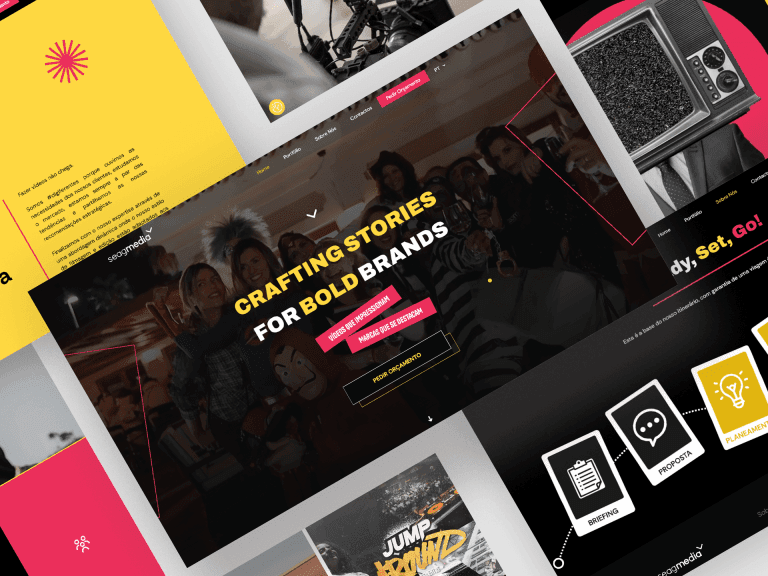
Website desenvolvido pela Apollotec
Unmatched flexibility and versatility
WordPress adapts to virtually any type of project.
Want to create a personal blog, an institutional website, an online shop, or a creative portfolio? With WordPress, all of this is possible.
You can start with something simple and, as your business grows, add features, pages, and integrations.
With the support of the plugin WooCommerce, for example, you can transform your website into a complete e-commerce site, with a payment system, order management and even automation.
It is a solution that grows with you.
Ease of Use
The WordPress interface is intuitive, even for those who have never created a website before.
The block editor (Gutenberg) allows you to build pages with ease, dragging elements and organising content visually.
In addition, there are page builders such as Elementor or Divi that make the process even more visual.
Without having to write a single line of code, you can create beautiful, functional pages that are aligned with your brand.
Huge Ecosystem of Plugins and Themes
One of the biggest advantages of creating a website on WordPress is access to its ecosystem.
There are thousands of themes (free and paid) that you can install with a single click.
The same applies to plugins that add features such as SEO, forms, social media integrations, security, backups, private areas, and much more.
All this without the need for programming.
Search engine optimisation (SEO)
The WordPress structure is designed to be easily indexed by search engines such as Google or Bing.
In addition, plugins such as Yoast SEO or Rank Math help you write and organise content so that it has a better chance of appearing in the top positions on Google.
With a good content and optimisation strategy, your WordPress website can gain consistent organic visibility.
Community and Support
As WordPress is used by millions of people, the community that supports it is enormous.
This means you are never alone. There are forums, tutorials, support groups, YouTube channels, and specialised professionals ready to help.
If you have a question, the likelihood that someone else has already experienced the same issue and found a solution is very high.
Cost-effectiveness
WordPress software is free. This means that to create your website, you only need to invest in a domain and good hosting.
Paid plugins and themes are optional and should only be purchased if you want specific features or more exclusive designs.
Compared to closed platforms that charge monthly fees and commissions, WordPress can be much more economical, especially in the long run.
Challenges of Creating a WordPress Website
Creating a WordPress website remains one of the best decisions you can make in 2025.
But, like any solution, it is not perfect. It is important to be aware of the challenges and, even more importantly, to know how to overcome them.
Learning Curve
If you want a website with very specific features or a fully customised design, you may encounter a steeper learning curve.
Not everything can be solved with plugins. Sometimes, you will need to tweak the code or configure more technical integrations.
Solution: You can start with a theme tailored to your needs and, as the project evolves, opt for custom development.
You can also learn from the community itself, which has loads of tutorials and forums.
Performance and speed
If you add too many plugins, heavy images, or use low-quality hosting, your website may become slow.
What affects user experience and Google ranking.
Solution: Invest in good hosting (preferably with servers optimised for WordPress), use caching plugins (such as WP Rocket or W3 Total Cache) and optimise all images before uploading.
Adding a CDN (Content Delivery Network) also helps speed up loading times.
Security
As the most widely used CMS in the world, WordPress is also one of the most frequent targets of attacks.
Solution: Keep WordPress, plugins, and themes up to date.
Use secure passwords, enable two-step authentication, and install security plugins such as Wordfence.
Make regular backups and, whenever possible, use a specialised maintenance service.
Maintenance
Unlike closed platforms, WordPress requires ongoing attention: updates, monitoring, and plugin management.
Solution: You can automate most of these tasks with proprietary tools, although it is always advisable to supervise everything on a regular basis.
For companies that don't want to waste time on these tasks, there are WordPress maintenance services that take care of everything for you.
Alternatives to WordPress
Shopify / BigCommerce
The alternative for those who want to create an online shop.
These platforms offer an integrated experience, with everything ready to go as soon as you create your account.
- When it makes sense: If you want to sell physical products and prefer a closed system with simplified inventory and payment management.
- Limitation: You have less control over design and features, and you usually pay monthly fees + commissions on sales.
Wix / Squarespace
They are very visual platforms with drag-and-drop builders. They allow you to quickly create beautiful and functional websites without technical knowledge.
- When it makes sense: For freelancers, portfolios, or small businesses that want to create a fast, beautiful, and hassle-free website.
- Limitation: Less flexibility to grow or customise. Some features are limited to paid plans.
Webflow
Combines the best of design with the freedom of a CMS.
It is widely used by designers who want to create customised websites with animations and advanced responsiveness without having to programme (but with a more demanding learning curve).
- When it makes sense: If you value design above all else and want to create a visually sophisticated website.
- Limitation: It may not be as intuitive for those who do not have experience with design or website structures.
Conclusion
With so many technological advances and new platforms on the market, it is normal to question whether WordPress is still the best choice for creating a website in 2025.
The short answer is: yes, it is worth it! And with complete confidence.
WordPress not only continues to lead in market share, but also maintains constant evolution, keeping pace with the needs of those who want to build a professional, secure website that is ready to grow.
Throughout this article, you have seen why WordPress remains relevant: flexibility, ease of use, SEO optimisation, an active community, and a cost-benefit ratio that is very difficult to beat. You have also seen the main challenges and how to overcome them with the right tools.
Of course, there are valid alternatives. But for most projects, whether it's an institutional website, a blog, or even an online shop, WordPress remains the perfect balance between freedom and efficiency.
If you are planning to create a website and want to ensure that the result is fast, professional and tailored to your business, you can book a meeting with our team.
Together, we analyse your case and help create the right solution without complications, without technical language, and always with your goals in mind.
FAQ'S
Will WordPress still be worthwhile in 2025?
Yes. Despite new platforms on the market, WordPress remains the most popular choice for creating websites thanks to its flexibility, active community, plugin ecosystem, and ease of use. It is a mature solution that is continuously updated.
What are the main advantages of WordPress?
The main advantages include flexibility to create any type of website, ease of use with visual editors such as Gutenberg and Elementor, a wide variety of themes and plugins, good SEO optimisation, and excellent value for money.
Do you need to know how to programme to use WordPress?
No. With visual editors and plugins available, it is possible to create and manage a complete website without writing code. However, for advanced customisations, technical knowledge may be useful.
What are the main challenges when using WordPress?
The main challenges include the need for ongoing maintenance, the possibility of slow performance if poorly configured, and the need for attention to security. All of these issues have affordable and effective solutions.
Is WordPress a good option for e-commerce?
Yes. With the WooCommerce plugin, WordPress becomes a powerful e-commerce platform, with features such as product management, online payments, shipping, and automation.
Are there better alternatives to WordPress?
It depends on the needs of the project. Shopify or BigCommerce are good options for simplified online shops, while Wix and Squarespace are better suited to more visual projects. Webflow is ideal for designers. But for most cases, WordPress continues to offer the best balance.
Request a Quote
Solicita a tua proposta personalizada e descobre como as nossas soluções podem transformar o teu projeto e impulsionar os resultados da tua empresa.